System Design & Integration
Let me walk you through some exciting decision analysis I did with the rest of the team
Brakes System Architecture Integration with Drivetrain & Electronics
I can't claim full credit, but I was a key part in devloping this exciting new architecture for a FSAE competition vehicle
Design Process Flow
Requirements Definition
At the highest level, produce the fastest car for an endurance event (22km)
Analysis has shown that a car with regenerative breaking (regen) will be lighter & faster by maintaining peak motor power for longer
Regen is limited because of increased heating in the battery
Thermals & Battery
To enable regen, the thermals and battery systems integrated a liquid cooled, flat battery pack.
However, regen can't be done in the beginning of an event because the battery needs to drain a little first. Therefore, regen is enabled only for the latter portion of a race
Regen turning on part way through means that the mechanical brakes are not needed throughout the entirety of the race
Line Lock
We use a line lock to "turn off" the mechanical brakes partway through a race and maximize regen, which maximizes charging the battery.
Mechanical brakes and regen have different effects on how the car steers, so switching from one to another fundamentally changes the "feel" of the car
Single Brake
If we have a single brake, mechanical brakes and regen have the same effect on the car, meaning the car is consistent to drive. A driver can adapt to a consistent car, they can't work with an inconsistent car
A brake on the differential will have high MOI
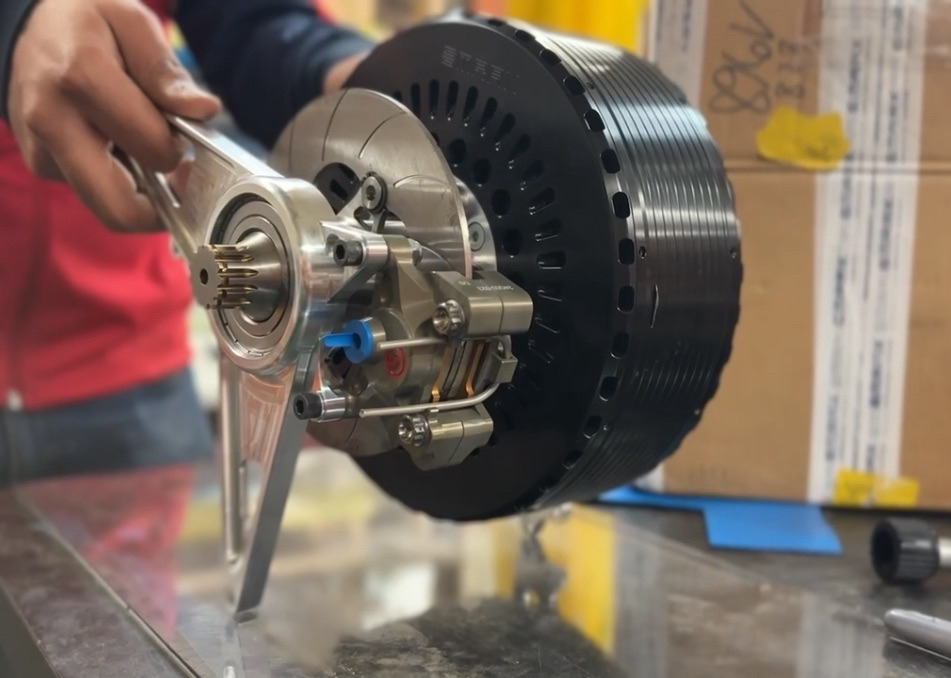
Brake on the Motor
If we place the brake on the motor instead of the differential as is traditionally done with single brake cars, we can use the transmission of the car to allow for a lighter brakes system.